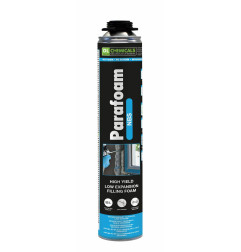
Parafoam Panelglue NBS - Sprayable PU foam - DL Chemicals

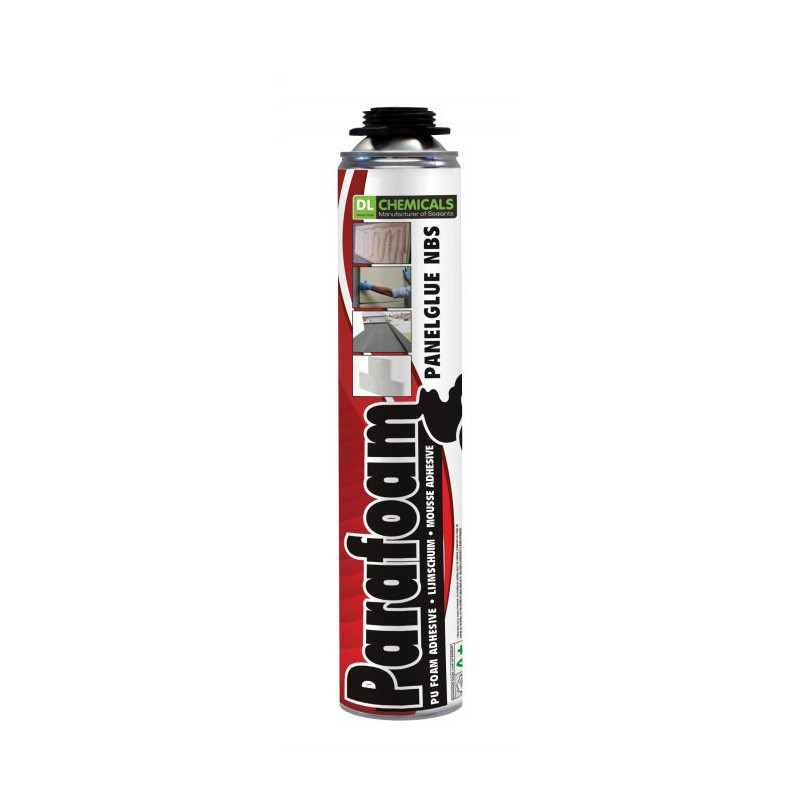
Sprayable PU foam for bonding insulation panels in external wall insulation systems (ETICS) and flat roof insulation. This adhesive PU foam is also suitable for sealing, insulating and filling joints, cracks and holes.
Packaging:
11 Items
$9.55Tax Included

Volume discounts

QuantityYou SaveUnit price
32 %$9.36
65 %$9.07
1212 %$8.40
DLC 101129
5413624350096

Parafoam Panelglue NBS - Sprayable PU foam - DL Chemicals

Sprayable PU foam for bonding insulation panels in external wall insulation systems (ETICS) and flat roof insulation. Also suitable for bonding wall panels in interior applications and bonding aerated concrete bricks for a non-load-bearing interior wall. This adhesive PU foam is also suitable for sealing, insulating and filling joints, cracks and holes.
  • Adhesive foam
  • Single-component polyurethane foam
  • Ready to use
  • Very good adhesion to almost all building materials
  • Very good water resistance
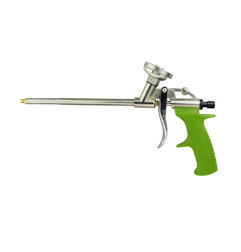
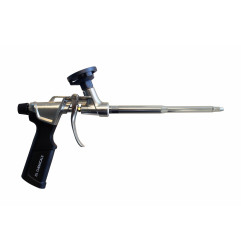
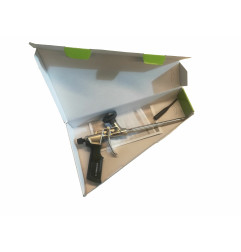
  • Very precise dosing with the NBS gun
  • Extremely low expansion and post-expansion pressure
  • Glued parts are loadable after ± 2 hours
  • Resistant to wind load

Applications:

  • Bonding of polystyrene (XPS, EPS) and polyurethane (PUR, PIR) insulation panels in external thermal facade systems (ETICS).
  • Bonding of lightweight insulation boards based on polystyrene (XPS, EPS) and polyurethane (light PUR and light PIR) in interior applications (test adhesion in advance).
  • Bonding of wall panels in interior applications such as MDF, plasterboard, gyproc, composite sheets and OSB panels.
  • Bonding of rapid cellular concrete bricks for non-load-bearing interior walls.
  • Bonding flat roof insulation to flat roofs (warm roofs).
  • Filling joints and cavities between insulation panels (if they are not exposed to UV rays)
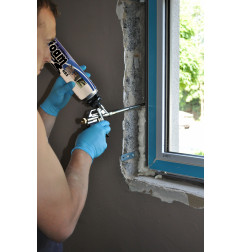
  • Window sill gluing.

Instructions for use:

  1. Preparation :
    • Wear gloves and safety glasses.
    • Do not apply in confined spaces. It is important to ventilate areas well during application and curing.
    • Warm cold cans with lukewarm water. Cans should not be heated above +30°C. Cans that are too hot should be cooled with water. Shake the can to reach the required temperature more quickly.
    • Check whether the substrate has sufficient load-bearing capacity. Ensure that existing coatings are load-bearing. Any non-load-bearing layers or loose parts must be removed. Pre-treat powdery surfaces with a suitable fixative.
    • Surfaces must be free of dust and grease. Lightly moistening dry substrates promotes curing and adhesion.
    • Shake the spray can vigorously at least 20 times.
    • Hold the spray can upright when screwing the NBS gun. Move the gun toward the spray can by holding the gun handle with one hand and screwing the can with the other. Do not tilt the can while screwing.
  2. Laid :
    • Hold the can upside down when extruding the foam. Adjust the amount by operating the adjustment screw and the trigger.
    • Shake the can regularly during treatment.
    • Return the can to the upright position with the gun after use.
    • Can also be applied without a foam gun with the EasyGun adapter
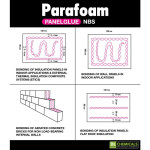
  3. Bonding of insulation panels in interior applications and exterior wall insulation systems (ETICS):
    • The bonding of exterior wall insulation systems is only permitted after the necessary prior study and knowledge.
    • The insulation panels used must be suitable for insulating external walls (see the insulation panel manufacturer's instructions).
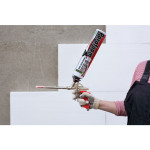
    • Apply the adhesive foam in strips of at least 30 mm diameter along the edges of the panel (± 3 to 4 cm from the edge) and in the middle, parallel to the longest side of the panel, so as to cover 40% of the surface after pressing the panel.
    • After applying the adhesive foam to the insulation panel, wait 2 to 3 minutes, then press the panel against the facade and put it in place.
    • If additional mechanical fixing of the panels is required, this must take place immediately after the insulation panel has been installed on the facade.
    • The adhesive foam is not tacky after 5 minutes. If the adhesive foam is already free of adhesive before applying the panel to the facade, the foam must be reapplied.
    • The insulation panels must be installed row by row, from bottom to top, so that they are supported. The insulation panels must be mitered at the corners. Please follow the panel manufacturer's instructions. During curing, the adhesive foam may expand slightly. Then push the panel back slightly. After about 2 hours, the adhesive foam has cured sufficiently and work can continue.
  4. Bonding insulation panels in flat roof insulation:
    • The processing temperature must be at least +5°C:
    • Bonding flat roof insulation is only permitted after the necessary preliminary study and prior knowledge of warm roofs. The insulation boards used must be suitable for flat roof insulation (see the insulation board manufacturer's instructions). The maximum unevenness between the insulation and the substrate is 1 cm. Shake the foam box regularly during processing. Prime the substrate if necessary (see the manufacturer's instructions for roof waterproofing/vapor barrier).
    • Start gluing the insulation panels at the point furthest from the roof access point and work toward the access point so that no one steps on the glued panels. Apply the adhesive foam to the insulation panels, forming ridges at least 30 mm in diameter every 20 cm. At least twice as much adhesive foam should be applied to the corners and edges of the roof.
    • In case of irregular substrates, grooves of at least 50 mm diameter must be applied so that 40% of the surface is covered after the panel has been pressed onto the substrate.
    • The consumption of adhesive foam or the appropriate number of adhesive beads is determined by EN 1991-1-4, in which the region, roof area, building height and position on the roof play a role.
    • After applying the adhesive foam to the insulation board, wait 2 to 3 minutes, then apply the insulation board to the flat roof within 5 minutes, pressing it firmly at the grooves.
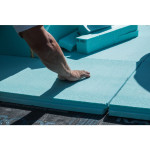
    • After pressing, do not walk on the panels for at least 2 hours. If the insulation panels have been moved while the foam is curing, the foam must be reapplied to the panels to ensure a good bond. Roof waterproofing can be applied after the foam has completely cured.
  5. Bonding wall panels in interior applications:
    • Apply the adhesive foam, forming ridges of at least 30 mm in diameter on the edges of the panel.
    • In the middle of the panel, apply the adhesive foam in a w shape so that 40% of the surface is covered after the wall panel is pushed in.
    • After applying the adhesive foam to the panel, wait 2 to 3 minutes, then press the panel against the support and put it in position.
    • The adhesive foam is not sticky after 5 minutes.
    • If the adhesive foam is already debonded before the panel is applied to the substrate, the adhesive foam must be reapplied.
    • The panel must be supported until the adhesive foam has completely cured. During curing, the PU adhesive foam may expand slightly. Then push the panel back slightly. After about 2 hours, the adhesive foam has cured sufficiently and work can continue.
  6. Bonding of cellular concrete bricks for non-load-bearing interior walls:
    • Parafoam Panelglue NBS is only suitable for bonding aerated concrete blocks to non-load-bearing interior walls up to 3 metres high (= 1 floor). Adhesive foam can only be used if uniform load distribution from one block to another is ensured.
    • The bottom row of stones should be placed with mortar so that they can be perfectly aligned.
    • For the following rows of bricks, apply the adhesive foam in two 30 mm diameter grooves parallel to the edge of the brick (approximately 3 to 4 cm from the edge) on the horizontal and vertical surfaces of the bricks. Always moisten the surface of the stone before applying the foam.
    • Wait 2 or 3 minutes, then apply the stone. Do not wait more than 5 minutes.
    • Let the adhesive foam that comes off the sides harden, then cut it out.
    • Each row of bricks must be level. If necessary, sand the stones.
    • Shake the foam can again at regular intervals.
    • The space between the ceiling and the wall can also be coated with Parafoam Panelglue NBS.
  7. Gluing the window sills:
    • Check if the surface is level.
    • Use spacers to support the window sill.
    • Apply the PU foam in 30 mm diameter beads parallel to the edge (± 3 to 4 cm from the edge).
    • Place the weights on the windowsill until the adhesive foam is completely cured (after ± 2 hours).
  8. Cleaning
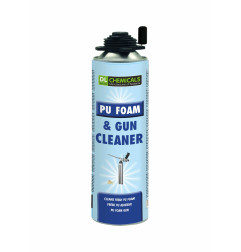
    • Cleaning fresh foam with PU Foam & Gun Cleaner. Cleaning hardened foam with Parafoam Remover.

Packaging:

  • 750 ml spray can

DL Chemicals
DLC 101129
11 Items

Data sheet

Signal word
DANGER
Hazard statements
H222 – Extremely flammable aerosol.
H229 – Pressurised container: May burst if heated.
H302 – Harmful if swallowed.
H315 – Causes skin irritation.
H317 – May cause an allergic skin reaction.
H319 – Causes serious eye irritation.
H332 – Harmful if inhaled.
H335 – May cause respiratory irritation.
H351 – Suspected of causing cancer.
H373 – May cause damage to organs.
Hazard pictogram
Hazard pictogram : GHS02 - Flammable GHS02 - Flammable
Hazard pictogram : GHS07 - Harmful GHS07 - Harmful
Hazard pictogram : GHS08 - Health hazard GHS08 - Health hazard
 

Specific References

EAN13
5413624350096

Quelles sont les déclinaisons et prix pour Parafoam Panelglue NBS - Sprayable PU foam - DL Chemicals ?

Parafoam Panelglue NBS - Sprayable PU foam - DL Chemicals - Déclinaisons, dimensions, prix, références
Variante Packaging Prix HT Prix TTC Prix dès 3 pièces (-2%) (TTC) Prix dès 6 pièces (-5%) (TTC) Prix dès 12 pièces (-12%) (TTC) Réference EAN-13 Stock* disponible
Parafoam Panelglue NBS - Sprayable PU foam 750 ml - NBS $7.96 $9.55 $9.36 $9.07 $8.40 DLC 101129 5413624350096 11 Pièce(s)
*Stocks disponibles, sauf erreur ou omission, en nos entrepôts de Lille (France) ou Tournai (Belgique), livraison en 24h/72h - Enlèvement gratuit - Expédition à partir de 4,99 € en France, 3,99 € en Belgique selon poids, délai et transporteur.